3rd Battalion, 34th Regiment, “Livorno” Infantry Division in the Gela Beachhead Counterattack: Sicily, July 11th-12th, 1943
In 1947, Lt. Col. Dante Ugo Leonardi, the former commander of the 3rd Battalion, 34th Infantry Regiment of the Livorno Division in Gela, Sicily, published a little book entitled “Luglio 1943 in Sicilia” (July 1943 in Sicily).
The book is a modest addition to the plethora of WWII subject books. It is utterly forgotten today, and will not be resurrected. Yet it retains an intrinsic value which does not deserve to be dissipated by “wasteful time”. Indeed it provides an Italian account, written by the unit’s commanding officer himself, as one of the bloodiest actions carried out by an Italian infantry unit in WWII.
Modern Italy does not even bother to devote to those unsung heroes a tenuous, fleeting thought. May this tiny contribution stands as a memorial.
Marching to Battle
3rd Battalion, 34th Infantry Regiment (commander: Col. C. Martini), led by Lt. Col. D. U. Leonardi, was attached to the “Livorno Infantry Division”, which was deployed in Sicily in November 1942. The Division was at nearly full strength; the artillery, engineers and 4 out of 6 infantry battalions were fully motorized (rarities, in the wartime Italian Army). It was the best Italian Division in Sicily, as it had been picked out and trained for the eventually evaporated Malta amphibious/airborne invasion.
In July 1943, the Division (commander: Gen. Giandomenico Chirieleison) represented the bulk of 6th Army’s reserve forces; it didn’t organically belong to either Army Corps (XII and XVI) constituting the 6th Army. Its acceptable degree of mobility made it the only Italian divisional sized unit suitable to be employed as Army level operational reserve.
Unlike most other Italian units in Sicily, the Division’s morale was relatively high and most officers’ leadership quality was good. However, the insufficient training plagued “Livorno” as well as the vast majority of Italian Army outfits at all levels, and sorely reduced its effectiveness in combat.
The Division’s troops were green. They had never been tested in combat.
When the Allied invasion of Sicily was launched, 3rd Battalion’s strength was 34 officers, 1100 NCOs, and enlisted men, (4) 47/32 mm guns, (6) 81 mm mortars, 12 machine guns and a flamethrower squad. It had taken up quarters in the Caltanissetta-Belvedere-San Cataldo area, in the central-southern region of the island.
At 00:30 am, July 10th, 1943, a regimental dispatch-rider arrived at the Battalion’s quarters carrying a written order. “Be this Battalion alarmed and ready for a possible action. Further instructions will follow.” At 5:00 pm on the same day, the movement order was delivered to the Battalion:
[wpsm_quote author=”” float=”left” width=”100%”]Enemy landed at Gela in the July 9th/10th night. Despite local defense reaction, enemy managed to establish a bridgehead. More landings ongoing in various southeastern coast localities. Enemy air activity much intense, especially along communication lines and over towns. This Battalion at 7:00 pm hours today, will initiate movement on vehicles towards Ponte Olivo (Gela Plain). Once arrived there, it will stop, waiting for further orders. ……1st Group [Battalion], 28th Artillery Regiment, specifically allotted to this Battalion for fire support. Direct agreement.[/wpsm_quote]
At exactly 7:00 pm the unit, in battle order, got on the trucks and vehicles and set off towards the assigned locality. The baggage (commander, Lt. S. Rossi) was left at the San Cataldo quarters: on the following day, it was destroyed by a heavy air raid, and the civilian population plundered all the surviving goods and materials.
Before dusk, an enemy aircraft formation strafed the traveling column. The attack caused limited damage (2 dead, 20 wounded, 5 vehicles damaged). It was the Battalion’s baptism of fire.
In the darkness of the night, the column stopped in the town of Mazzarino and the officers asked a Carabinieri (military police) patrol about the right way to Gela. There were some groups of civilians, silent and cold. They looked by no means enthusiastic towards their own troops, as Leonardi later recalled.
At the Butera-Gela road fork, Leonardi received a written instruction coming from the Regiment commander:
[wpsm_quote author=”Regiment Commander” float=”left” width=”100%”]You will attack the Americans in the early hours of tomorrow July 11th, towards Gela. Deploy the Battalion, under the cover of darkness, between Ponte Olivo and Mount Castelluccio.[/wpsm_quote]
Leonardi was quite surprised by the generic, insufficient information conveyed by the message. Where precisely was the enemy? Where was the beachhead’s front? How strong was the enemy? Where were their forward lines, and where were ours?
At 11:00 pm, the column reached Ponte Olivo. The place looked deserted and nobody was around, except for a few soldiers guarding a bridge, who didn’t even know the whereabouts of the nearest Italian units! No further information!
The troops dismounted and the whole Battalion headed south, by foot, wandering across the fields, literally seeking the first enemy line. After a few kilometers, the rambling Battalion came across an anti-tank unit in position astride Highway 117, the main road leading to Gela, but its commander had just arrived there, too, and did not know anything about the situation. Lack of information and disorganization were rampant that night. However, the antitank unit officer pointed to a nearby artillery battery. Perhaps they would have a clearer idea about the situation. The battery commander, a Lieutenant, finally accompanied the Battalion’s officers to Mount Castelluccio (Castle Hill).
Up there, they found the 155th Bersaglieri Motorcycle Company, led by Lt. Franco Girasoli, wounded in action during the July 10th attack on the beachhead. His company, belonging to the Mobile Group E, had suffered heavily, and the remnants were holding the hill. It was the only Italian infantry unit left in the area prior to the 3rd Battalion’s arrival. Girasoli was a capable and valiant officer and his elevated fighting spirit impressed Leonardi.
The Preparation
Behind Mount Castelluccio there is a wide depression, seeming almost perfect as a safe deployment area for the Battalion; the men would have been sheltered from the enemy line of sight, and partly from enemy fire. However, very little information was available about the foe that the Battalion would have faced on the next day. It was American infantry, dug in along a row of hills not far away from Mount Castelluccio and south of it.
At dawn, the Battalion was ready for action. Units, weapons, the ammunition supply post had all been arranged and prepared the best possible way. No traces yet of the Artillery Group which would have supported the Battalion’s attack. According to the previous day’s orders, a Battalion’s company, (the 11th), was positioned quite far away from the other troops. This was partly due to a bad understanding of the orders issued and deployment errors caused by night movement across unknown areas. This would have had brought about several drawbacks and worries during the subsequent actions.
The Battalion’s officers, while awaiting the attack order, inspected the terrain in which their troops would soon have crossed under fire. The nearest enemy elements were located on some hills around 800 meters south of Mount Castelluccio. Overhanging the flat terrain and completely bare, stretching between Castelluccio and the hills themselves, was devoid of vegetation (corn had been reaped just a few days before), and nearly featureless aside from a few shallow ditches here and there. The troops would have been fully exposed to automatic weapons fire for the whole duration of the action.
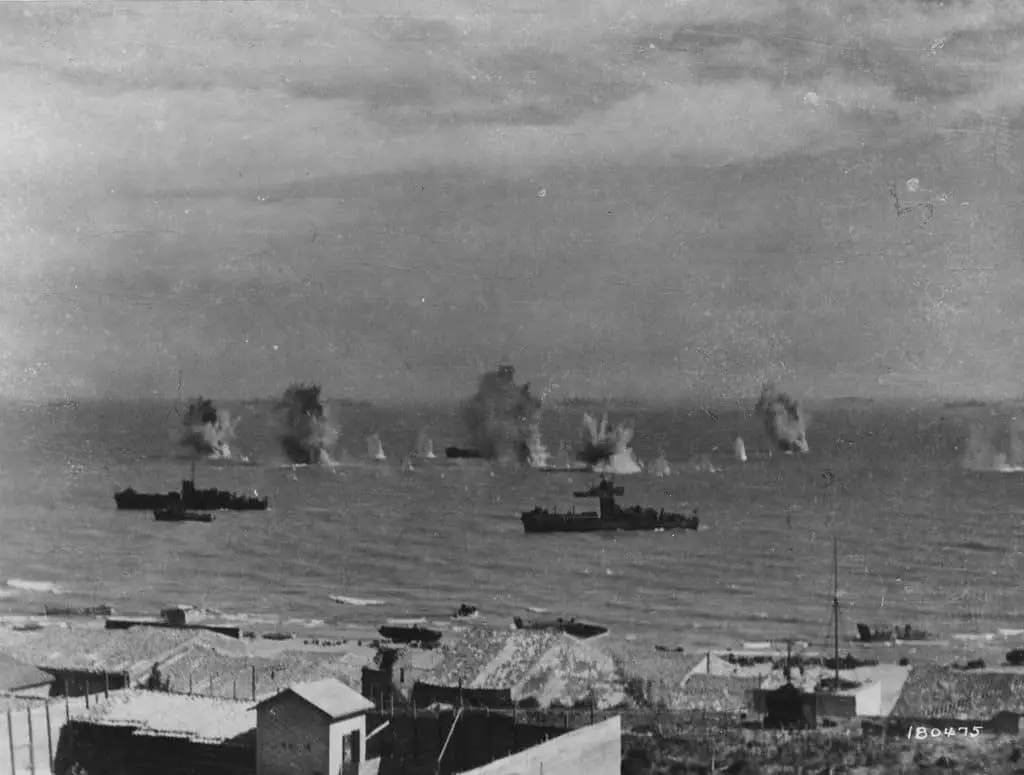
Axis aircraft bombing Allied ships at Gela.
Lying on a hilltop, on the southern horizon, the town of Gela, nearly 4 kilometers away was visible, inviting and alluring. Farther south, the blue sea… powdered with countless Allied ships. It was a majestic sight.
The Plan
A Captain, quickly came from the Division HQ and delivered the attack order.
Three strike columns would have simultaneously assaulted the beachhead, starting at 6:00 am, after 10 minutes of artillery barrage fire. Objective: Gela. The right column was the 33rd Infantry Regiment of the “Livorno” Division. The left column was the German “Hermann Goering” Division. The center column was the 3rd Battalion, 34th Inf. Regt.
It was immediately obvious that while the main effort had to be exerted by the far stronger right and left columns, the 3rd Battalion would just have supported their drive by pinning down the Americans in front of it and pushing them back as the other two pincers progressed toward Gela.
The Battalion had no radio gear to get in touch with the other attack forces, and low hills separated it from the neighboring columns and even forbade visual contact. Thus each strike force was separated from the others and, as it turned out during the fighting, the counterattack was marred by the utter lack of both coordination efforts as well as American firepower.
Even worse, while the two main prongs of the attack were being stopped, badly mauled and driven back, the 3rd Battalion, without any knowledge of what was going on elsewhere, still kept on moving forward, eventually finding itself exhausted and stuck in the outskirts of Gela – alone and isolated.
Infantry reinforcements were promised – however, they never arrived.
The Onrush
The Battalion was set up in assault array:
9th Company (Capt. Capello), forward left
10th Company (Capt. Ferrara), forward right
11th Company (Lt. Florio), behind the 10th
12th (Heavy Weapons) Company (Lt. La Torre): 47/32 mm guns with the forward infantry companies; flamethrower squad with 9th Coy; 81 mm mortars on Mount Castelluccio;
HQ Company
At 5:50 am, just when the supporting artillery should have opened fire, the I/28th Artillery Group was not ready to accomplish its fire mission yet. Major E. Artigiani, the Group commander, had reached Mt. Castelluccio just a half an hour before. Artigiani, inside a shell crater, was striving to establish a radio connection with his gunners. The guns were also arriving from the San Cataldo area and had to be set up 2 kilometers north of the infantry forward line.
The attack was delayed until 6:30 am to allow time for the artillery to get ready, but when the order was issued, the guns didn’t fire – they entered the fray later when the attack had already been launched. The delay seemed to last forever and the Battalion’s officers grew nervous with the tough situation. It was a three-pronged coordinated and simultaneous attack on a broad front to be executed by three separated strike forces. A further delay might cause very heavy consequences leading to an unqualified fiasco. On the other hand, attacking a superior enemy without artillery support meant running even greater risks with the troops possibly undergoing harsher punishment. Leonardi notes: “Under such circumstances, all that we can do is to trust the goodness of God”.
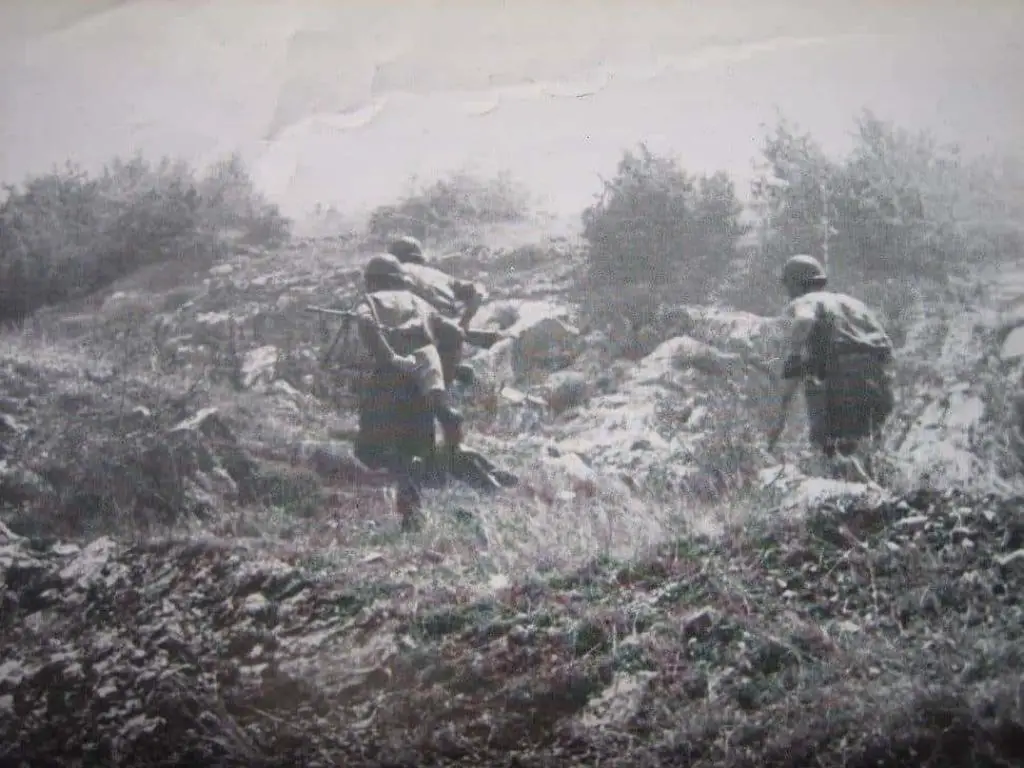
3rd Battalion, 34th Regiment Livorno begins the assault towards Gela.
At 6:30 am, the troops, with the officers ahead of their men, leaped out and surged forward towards the enemy. As soon as the attack started, American guns and mortars opened a massive suppression fire on the attackers. Casualties began to mount up. Capt. D. Capello, 9th Company commander, was wounded twice very soon. 30 meters away from the Battalion commander, who was with 10th Company, a shell splinter lopped off a soldier’s head.
The Battalion’s heavy weapons, light guns, and mortars delivered blow after blow to the enemy positions, and this somehow helped to counterbalance the American fire, whose volume increased as the Italians got nearer. Eight American infantrymen with 2 machine guns were inside a small house on the battlefield; their accurate fire was a serious hindrance to the Italian advance. Lt. La Torre, with a handful of riflemen, attacked the outpost with hand grenades. The Americans were captured. Sergeants E. Caponi and Q. Ghioni, 9th Company, proved their valor in the face of death, Ghioni being wounded twice, but going on leading his squad to seize an enemy automatic weapons post. He was eventually killed.
At around 8:00 am, the Battalion reached its first objective line. The US infantry encountered [probably, Company K, 3rd Battalion, 26th Infantry Regiment] was not solidly entrenched and made no further attempts to stand; it swiftly fell back, leaving several prisoners and weapons in Italian hands.
Italian losses had been quite heavy, but that was only the beginning. For along another chain of low hills, 500 meters south of the just seized position, a more solid and better organized American defense line [Darby’s force] greeted the already worn out Italians with a withering fire. The worst was still to come.
The Slaughter
The much longed for artillery support, at last, thundered overhead and the first shells hit the U.S line. It was a morale boost for the green infantrymen, who had seen so many numerous comrades fall in their very first war action.
But it was a short-lived illusion. Hell broke loose as US naval gunfire added its weight to the field artillery and the heavy mortars and beat the battlefield like a carpet, hammering away at the unarmored infantrymen with huge violence.
The Battalion resumed the attack but the enemy reaction proved very tough this time, and movement was considerably slowed down while casualties became rapidly staggering. It took the companies 3 hours to cover 500 meters. Shells, splinters, and bullets zinging and sweeping across in the thousands and exploding everywhere on the flat ground were simply slaughtering the men. It was a cataclysmic scenario and the uproar of landing shells, deafening. Yet the troops did not give up and persisted to advance. (Infantry elements of the German Hermann Goering Division, being as badly battered as the 3rd Battalion, broke and ran).
Unfortunately, the pitiful training of the Italian infantry made things even worse. Instead of scattering across the field to increase the very few survival chances in the high explosive storm, many men formed packed groups, seeking refuge in the comrades’ presence. Obviously, this automatic reflex was paid for with more human lives mowed down.
Finally, 9th Company communicated to the Battalion HQ that due to the bloody losses suffered and the relentless American fire, it was unable to further move. All company officers had been killed or wounded.
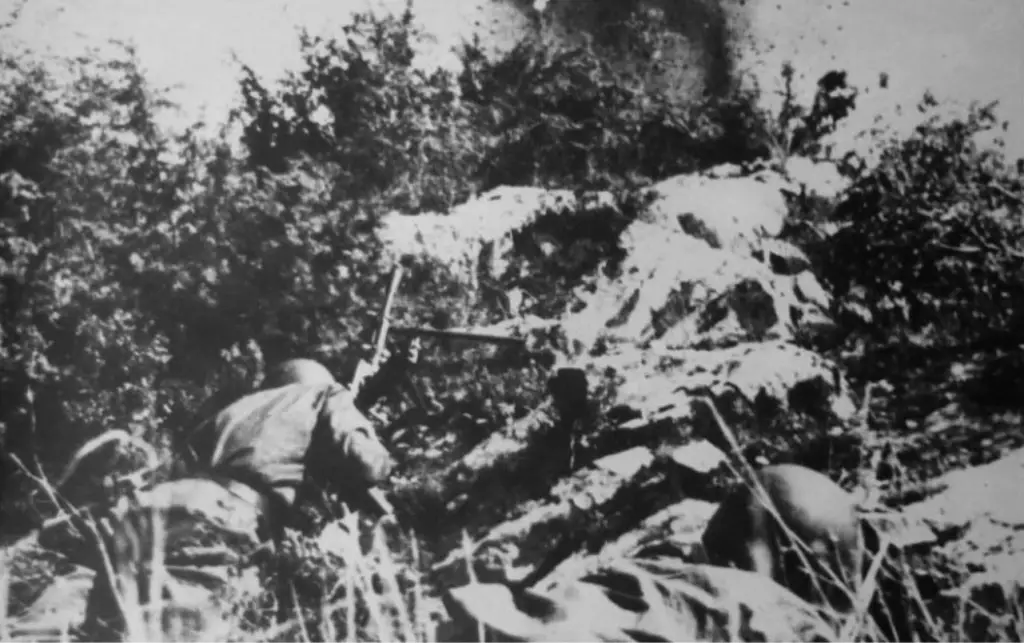
Italian soldiers on the receiving end of U.S. naval gunfire near Gela.
In the meantime, 10th Company was being cut to pieces. It had managed to get very near the U.S posts, but by now it was being hit frontally by a torrent of bullets, enfiladed from the left, and smashed by naval gunfire and mortars. The company commander, Capt. Ferrara, was heavily wounded and two out of three platoon commanders were killed.
An American machine gun selected as its target the Battalion HQ. The HQ personnel found a meager cover in a shallow ditch, but they were pinned down and couldn’t move. Sergeant E. Benassi, lying in a ground hole, managed to take up a Breda submachine gun and a deadly duel began. Sgt. Benassi stood very slim chances of making it against the MG and everybody expected to see him die very soon. But a prolonged burst of the Breda silenced the MG a few minutes later.
The Battalion was thus stuck on the open ground and being quickly chewed up by a hail of lead and steel which no other troops in the world could have withstood for a longer time. Losses were horrendous and the breaking point was near.
That very moment, however, the reserve company, the 11th, sprang forward and hit the American elements, enfilading 10th Company, while the remnants of 9th and 10th Company joined the assault getting within hand-to-hand combat distance.
The enemy avoided the infantry shock by disengaging and withdrawing. More prisoners and abandoned equipment were seized.
The fighting petered out. At 11:00 am, the battalion seized the American line and fire ceased.
Leonardi inspected what was left of his exhausted unit. 10th Company had been reduced to 30 men and no officers; they formed a platoon under Lt. Petrillo. The other companies were not in much better shape. 9th Company’s strength became halved.
Lt. Baldassare, commander of the recon platoon, was ordered to go on patrol duty and observe the enemy’s moves. Later during the day, he sent the following message back to the Commander: “No traces of Americans in the area we patrolled. They are still falling back into Gela. Patrol stands near the Gela roadblock. Waiting for orders.”
It was clear that the Americans had retreated into the town of Gela. Fighting inside the town in those conditions was out of the question; a folly, which would have destroyed the Battalion to the last man. Nothing was known, moreover, about the outcome of the other two prongs’ attacks.
Nevertheless, Leonardi thought it expedient to take advantage of the lull by pushing forward at least on the outskirts of the town, to the Gela roadblock.
While the troops were progressing, the Regiment commander, Col. C. Martini, sent an encouraging, cheerful message, praising the Battalion for its “superb behavior in battle” and “the brilliant result attained”.
Just when the companies had reached the Gela roadblock position and were digging in, naval gunfire suddenly hit them murderously. Major Artigiani died and several officers and soldiers wounded, including Lt. Baldassare and Lt. Mascellani, platoon leader of the 11th Company.
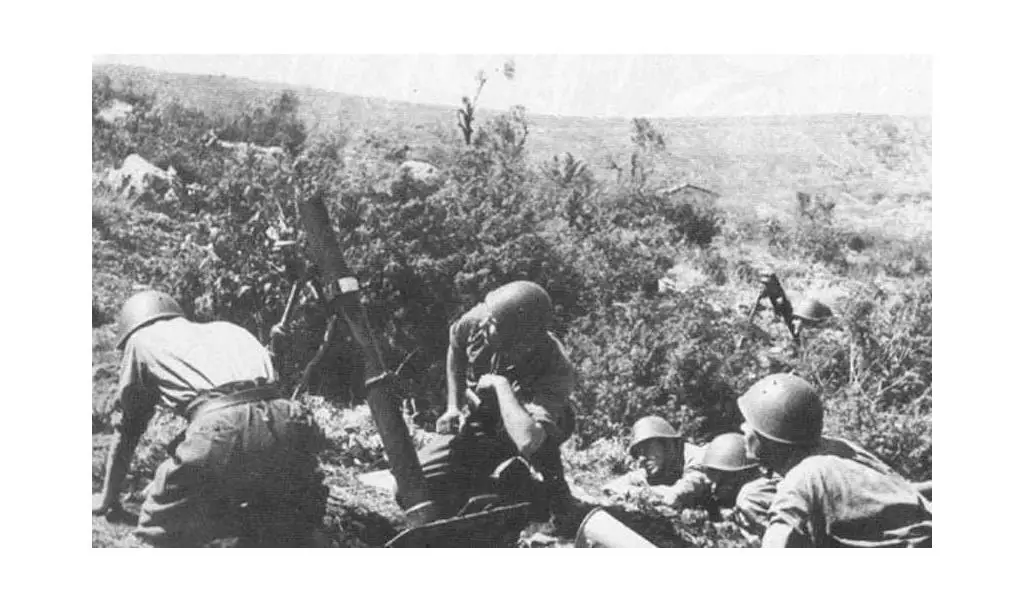
Italian mortar action against American forces at Gela.
Leonardi wrote an abridged report to Col. Martini, pointing out the heavy losses suffered (only 400 men remained) and the critical conditions of the unit, as well as the utter impossibility to go farther. Urgent requests came for ammunition, fuel for the supply vehicles (mostly “motor tricycles”), and reinforcements. The Regiment commander replied that he had already requested reinforcements and they should have been on the way; the Battalion had to consolidate its gains, guard the conquered position and repel any attacks until the arrival of the reinforcements.
In the afternoon, some reinforcements arrived. Not the infantry battalion expected, but the 3rd (divisional) mortar company of the Livorno (commander, Capt. A. Abate). The disappointment was bitter. The men couldn’t believe that the Division would have left them in the lurch. A mortar company was a joke of a reinforcement in those conditions.
Anyway, the 81 mm mortars were set up on Colle Frumento, a nearby hillock. During the day the mortars opened fire on enemy objectives on several occasions. The unit was well led and well trained. It managed to escape encirclement and destruction on the following day. Leonardi went personally to Col. Martini’s HQ post, to further clarify the situation and beg for more reinforcements. The Colonel was very sorry, but he was unable to pour more troops into the battle.
Italian mortar action against American forces.
The other two battalions of the 34th Regiment detached from the Regiment and assigned to other tasks elsewhere. Leonardi remarks on the disastrous mistake of splitting up the Regiment, as it prevented a build-up of striking power that would perhaps have allowed the Italians to retake Gela.
The Night
At nightfall, the Battalion was informed that the other pincers of the Axis counterattack had been driven off with heavy losses. At that point, it became obvious that the all-out counterattack had failed, but the Battalion still was anxiously awaiting reinforcements. Gela was just a few hundreds of meters south of its positions.
At 10:30 pm, an exchange of shots alarmed the left flank of the Battalion (held by 9th Company). A few American reconnaissance or raiding parties had tried to pass it and some elements had managed to infiltrate the Company’s rear before being repulsed. 9th Company had some casualties.
At midnight, the last dreams of victory vanished. The order came to withdraw the Battalion to Mount Castelluccio and hold the hill at all costs against any enemy attacks for the following day. It also allowed the rest of the Livorno Division to disengage, then reconstitute a defensive line farther north.
Though extremely disappointed and embittered, having to evacuate the battlefield they had conquered with the loss of so many comrades, the troops marched back to their start line. The seriously understrength 9th Company was left at the Gela roadblock as a rearguard.
As they were retreating to Mt. Castelluccio, they heard the uproar of battle coming from the positions they had evacuated. 9th Company was under attack. The Americans were coming to finish off the depleted Battalion, regain the lost ground, and secure a larger perimeter to the beachhead.
After approximately one hour of fighting, 9th Company, outflanked and running short of ammo, either escaped to join the Battalion on Mt. Castelluccio, or scattered in the darkness.
In his book, Leonardi praises the fine and effective American night combat training. In night actions, they usually showed a high fighting ability, skillful surprise, exploitation, and tactical proficiency. It was the result of a thorough and intense training with tactical and operative success as the prize. This special ability contrasted with the sad and absolute inferiority of Italian regular infantry in night combat. In the Italian Army, night combat was considered to be an “exceptional” situation and as such, scarcely taken into account!
On Mt. Castelluccio, there still was the 155th Bersaglieri Motorcycle Company, or rather, the few remnants of it. The skeleton Battalion took a hastily arranged defensive position on the hill.
The End
Just before dawn, July 12th, 1943, a brief but crushing artillery barrage fell on the hill, “with telling effects” as the US official history remarks. Field guns, as well as naval guns, lobbed hundreds of shells at the Italian positions wreaking havoc among them. When the barrage ceased, US infantry came up, attacking frontally first, then outflanking and encircling the Italian units.
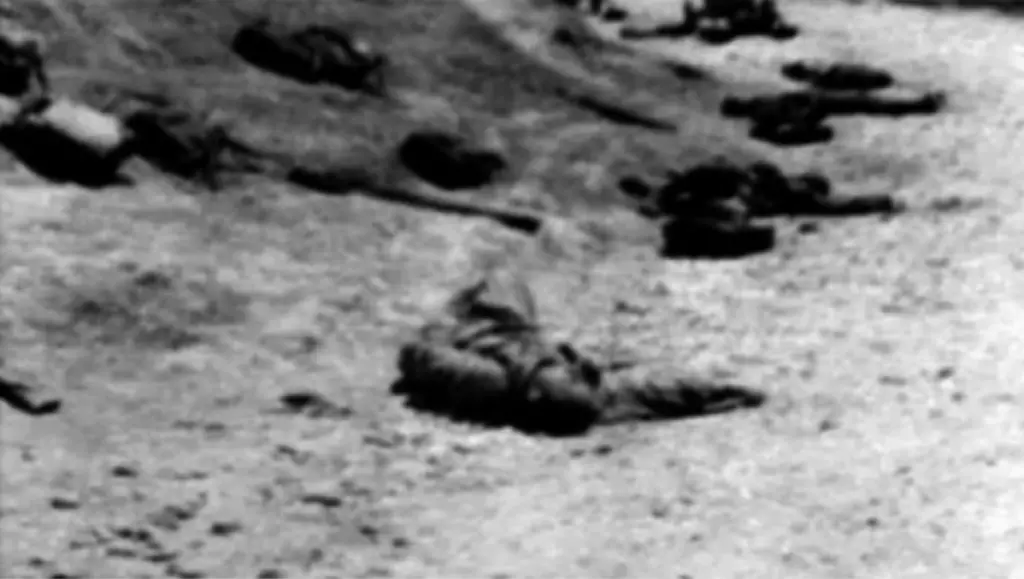
Image of dead Italian soldiers from the Battle of Gela.
At 7:00 am, after a desperate fight, the enemy spearheads were 50 meters away from the Battalion HQ. The surviving elements became overwhelmed by the attackers and subsequently captured.
After 24 hours of bitter struggle, the valorous 3rd Battalion, 34th Infantry Regiment, no longer existed.
70% of the Battalion’s initial strength was dead, missing or heavily wounded. That was the blood price paid for the clash between flesh and iron.
The Map
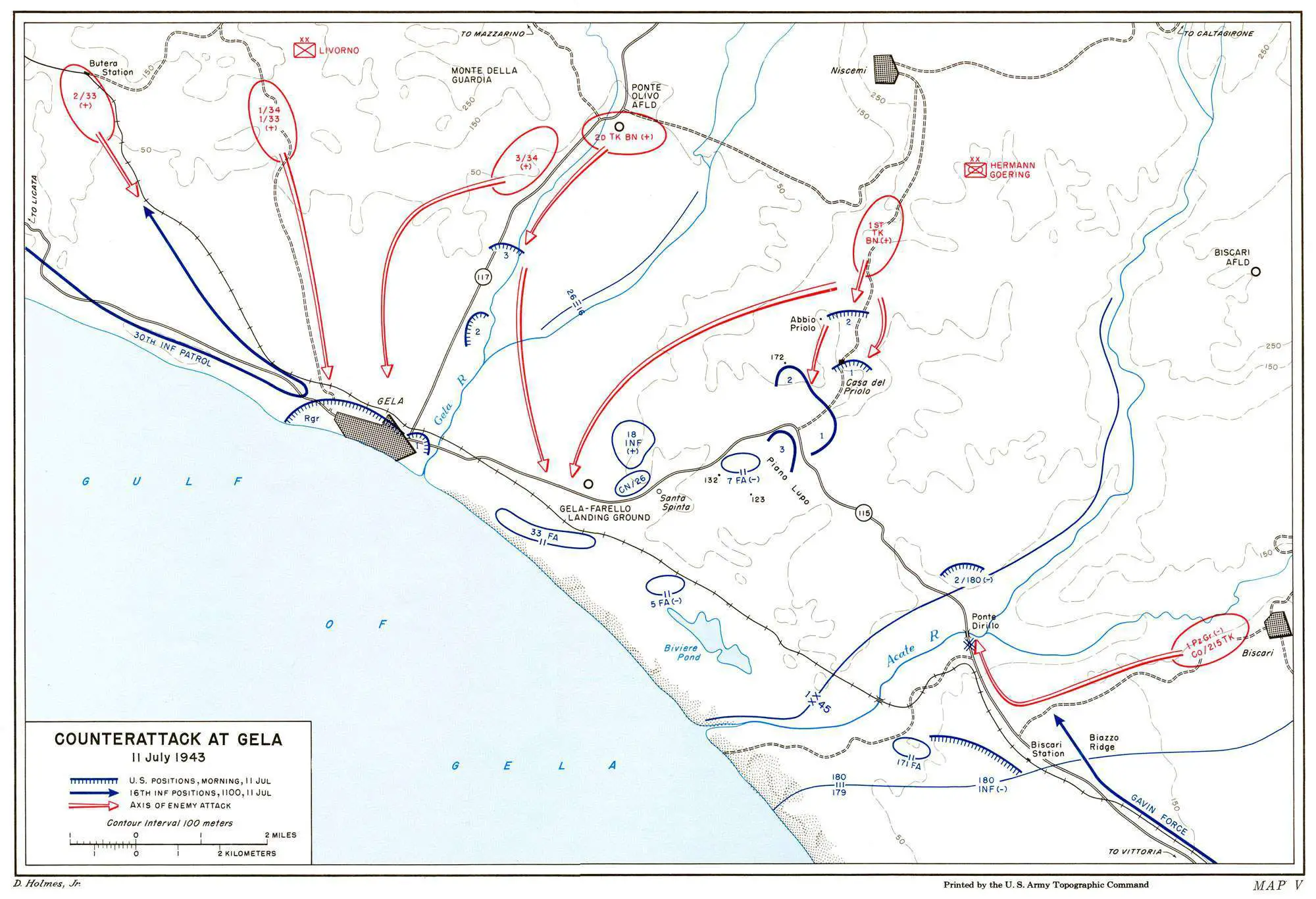
The Gela battlefield map.
Article courtesy Alessandro Gazzi