The world was experiencing many changes between the two world wars. Italy grew from a relatively new country to a diplomatic and military superpower. This article identifies a number of events that sealed the destiny of Italy before World War Two.
Mussolini Coined the Term “Axis”
The term “Axis” was first coined by Benito Mussolini in a speech he gave in Milan, Italy on November 1, 1936. In this speech, he referred to the Rome/Berlin alliance as an Axis in which all European countries would revolve around. This alliance, however, developed as a result of forced isolation, rather than a sincere Italo-German partnership of mutual respect.
In fact, in 1934, Italy almost went to war with Germany over a potential German attempt at annexing Austria.
Austria

A 17 March 1934 photo of Engelbert Dollfuss, Benito Mussolini, and Gyula Gömbös.
Austria’s independence was immediately threatened when Hitler assumed power in Germany. He made it clear that expansion was his goal, with Austria’s large German-speaking population as the logical choice. But this did not sit well with Mussolini and his fascist government. In 1934, Austria was protected by Italy and it’s Chancellor, Engelbert Dollfuss, was a friend of Mussolini. Even if Austria was a small nation, it provided a buffer between the borders of Germany and Italy. To Mussolini, this border was to be maintained at all costs, and he vowed to protect Austria’s independence with military force.
Mussolini Meets Hitler
The first meeting between Hitler and Mussolini occurred on 14 June 1934. Mussolini understood some German so he refused a translator for this meeting. Hitler was advised not to wear a uniform, in order to appear more as a diplomat, rather than the warmonger as perceived by the Italians. Hitler appeared wrinkled and untidy compared to the authoritative, tailored uniform of Mussolini. In the meeting, Hitler advised Mussolini to stop trying to protect Austria and that he wanted Chancellor Dollfuss replaced. Mussolini replied that the persecution of Jews was folly. Neither dictator may have understood what each was saying.
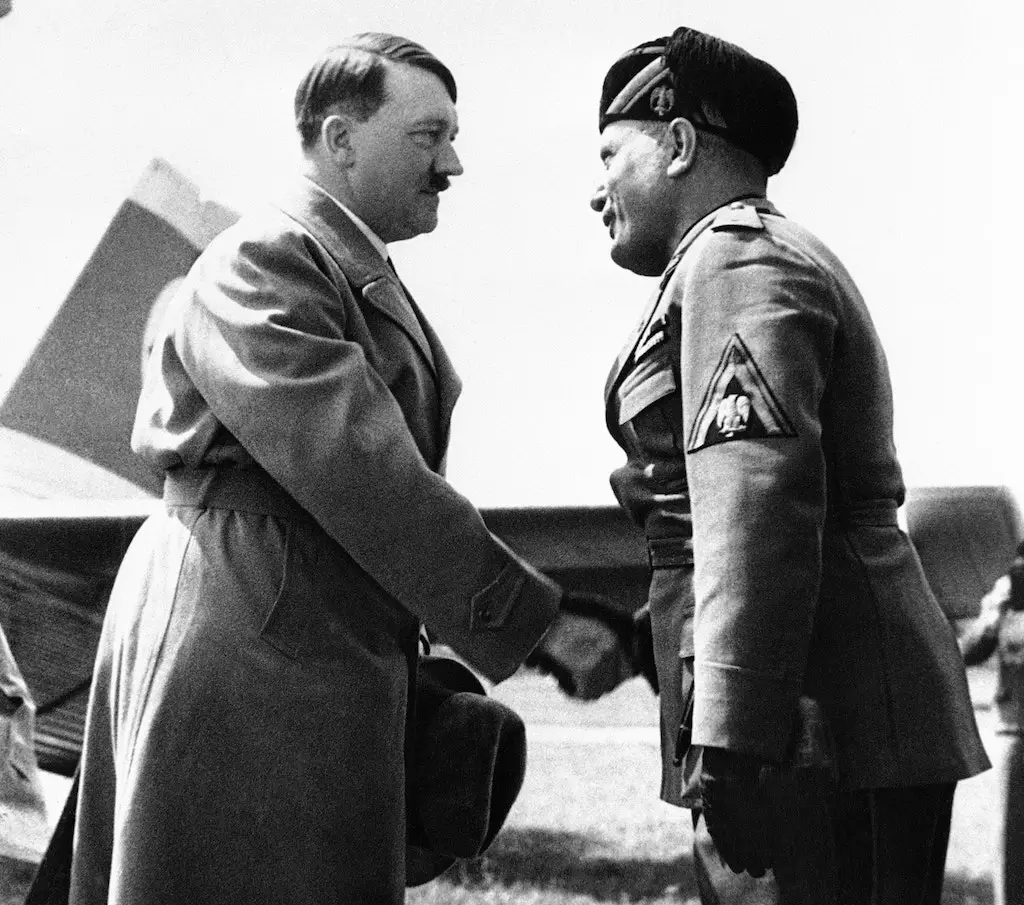
Hitler meets Mussolini for the first time in Italy, 14 June 1934.
Hitler returned to Berlin assuming that the German acquisition of Austria was approved by Italy and Mussolini returned distrusting the Germans even more. On 25 July 1934, Nazi assassins killed Chancellor Dollfuss in his office. The day he was killed, Chancellor Dollfuss was scheduled to fly to Italy for a meeting with Mussolini. His family was already there waiting for him. Once word spread of his murder, Mussolini had the difficult task of telling his family in Rome.
Mobilization Against Germany
Mussolini was well aware that Chancellor Dollfuss was murdered by Nazi operatives. He then made two bold steps. He ordered Italian troops mobilized on the Austrian border and sent a wired telegram to Austria promising Italy’s help in the defense of her independence. Mussolini expected France and England to send the same message, but that never happened. Mussolini was confronting Germany alone.
Germany was not yet prepared for war and Mussolini’s bold stand was enough for Hitler to abruptly change his plans.
The Nazi press, which prepared a special edition to announce Dollfuss’ assassination and the fall of Austria, ordered a last-minute cancellation of the publication and revised it with statements from Hitler condemning Dollfuss’ murder. Hitler had the assassins arrested and deported to Austria for trial. He also recalled the German ambassador to Austria and sent in a replacement with instructions to seek better relations.
Mussolini emerged as a hero and won the admiration of England and France. Mussolini felt very confident in his position in the political world. He used this to advance his prospect of a new Roman Empire. This admiration, however, would soon to replaced by the international embargo. The isolation of Italy began with their invasion and annexation of Ethiopia.
Invasion of Abyssinia (Ethiopia)
Although Italy fought with the allies in World War I, it did not feel that it received an equal share of the spoils of the Central Power’s defeat. Mussolini considered it a great injustice that France and Great Britain could increase their colonization, yet Italy only received minor gains. Ethiopia was always considered in the sphere of Italian influence. It was also one of the few remaining countries of Africa which still preserved its empire free of European domination. Italy was also one of the few countries defeated by an African power in a military engagement. This occurred in Adwa in 1896 when the Italians suffered a humiliating defeat at the hands of the Ethiopians.
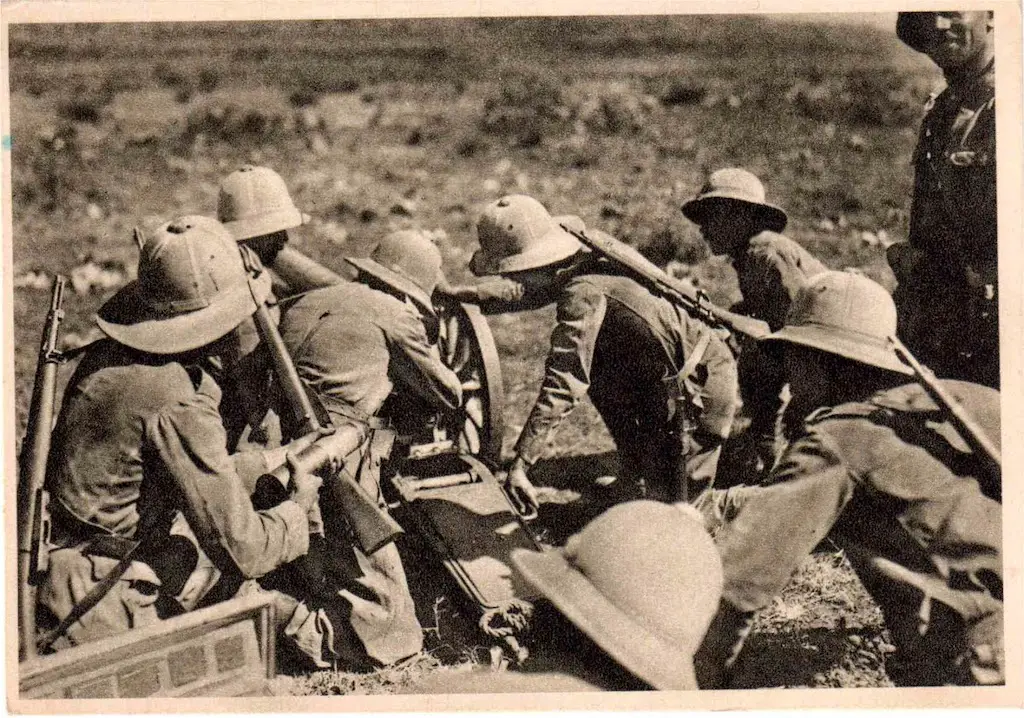
A 1936 photo of Italian forces during the invasion of Abyssinia.
Fueled by the need for revenge and expansion by colonization, Mussolini sent his newly mechanized legions under the command of Field Marshal Rodolfo Graziani across the Abyssinia border from Italian Somaliland and Eritrea on October 3, 1935.
In 3 days, Adowa was engulfed and within a month, Italians were 80 miles into Abyssinia. Resistance was heavy throughout the country, so Graziani began to rule with an iron grip. He destroyed the Intelligentsia and killed many of the Coptic Church in reprisal for partisan attacks. Field Marshal Pietro Badoglio took command later in 1935 and immediately resorted to mustard and other poisonous gases on a number of occasions to quell the unrest.
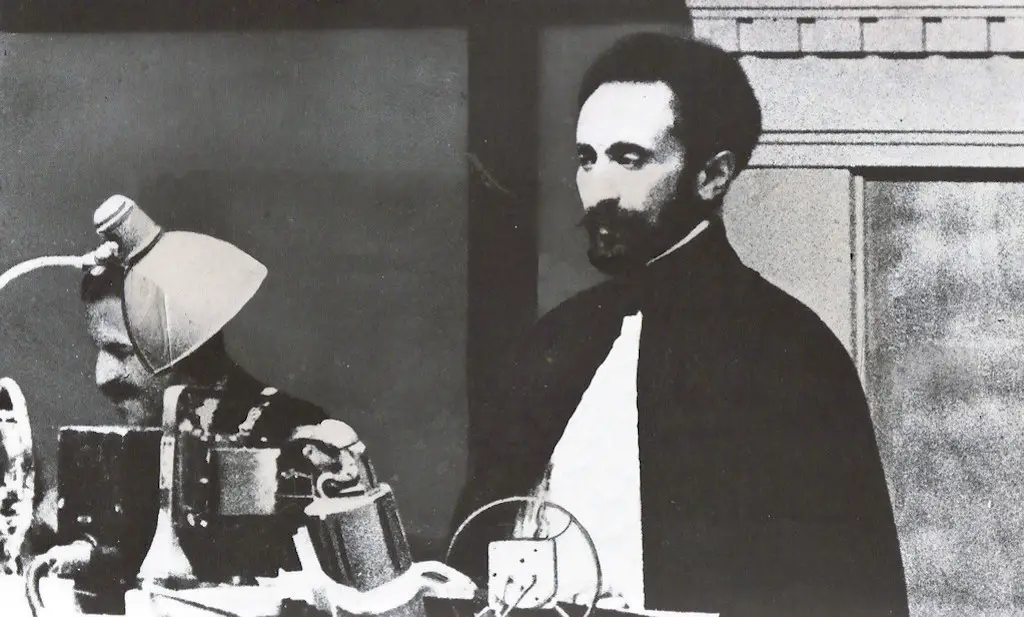
Haile Selassie addressing the League of Nations in Geneva, 1936.
By early 1936, his hard-hitting campaign crushed all organized resistance in the country. On 5 May 1936, the Italian army marched into the capital of Addis Ababa and Ethiopia surrendered. On 30 June 1936, Ethiopian Emperor Haile Selassie, who escaped the invading Italians, spoke before the League of Nations in Geneva, Switzerland, in protest of the attack. He was an emperor without a nation. “It is us today. It will be you tomorrow,” he warned. The League of Nations decided not to respond militarily and gave minor economic sanctions against Italy. These sanctions did nothing to cripple the Italian economy and were lifted two weeks after Emperor Selassie spoke to the League.
The Spanish Civil War
When General Francisco Franco fascist troops invaded Spain in July 1936 with the purpose of overthrowing the young and unstable Republic, he knew he would need help. On 20 July 1936, General Franco sent emissaries to Hitler and Mussolini requesting military aid and technical assistance. Mussolini promptly accepted the offer. He initially sent 12 planes escorting troopships from Africa to Spain, but eventually, 37,000 men and every spare aircraft he could afford poured into Spain. Many Spaniards considered these Italian “volunteers” as invaders and fought back with arms and propaganda. The Germans followed suit and also sent some aircraft and the Condor Legion.
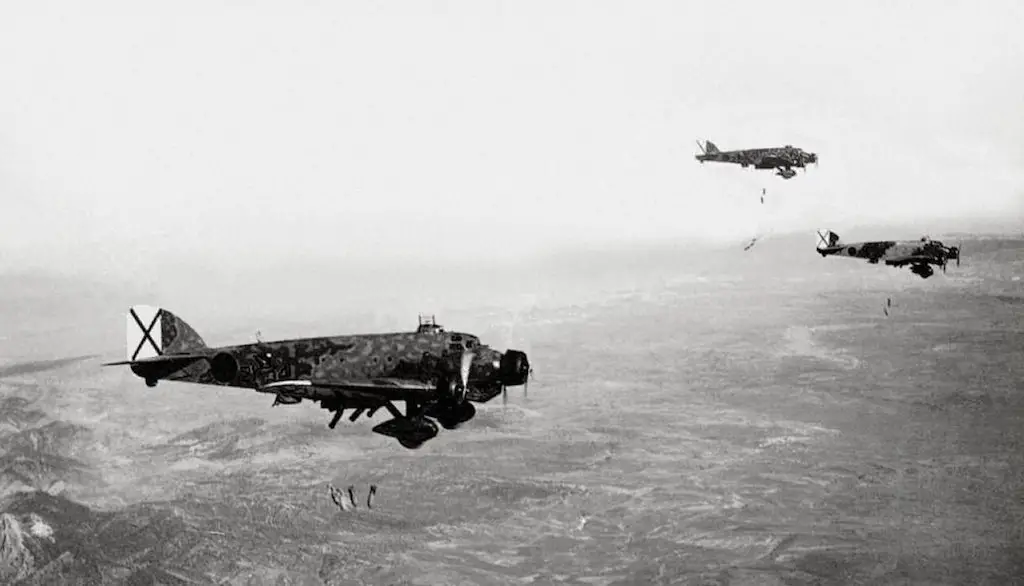
Italian Savoia Marchetti SM.81 bombers dropping ordnance on Spanish soil in 1936.
The Spanish Civil War allowed Italy to exercise its use of its weapons, especially the Air Force and Army, but more importantly, it allowed the Germans and Italians the opportunity to coordinate its military forces in combat. What would later prove to be one of its deficiencies, Italy utilized the “true and tested” method of combat, while Germany embraced a new radical method of war.
The Spanish Civil War and the Ethiopian conquest became a large drain on the Italian economy and this would haunt them in the years to come.
Invasion of Albania
The invasion of Ethiopia and Italian assistance in the Spanish Civil War blacklisted Italy from the Western powers. Mussolini found himself in forced cooperation with Germany. This time when Hitler asked for Italy’s approval for an invasion of Austria to “restore order”, Mussolini endorsed it. On 12 March 1938, German tanks rolled into Austria unopposed. Hitler was overjoyed. He was quoted saying to an aide “Tell Mussolini I will never forget him for this.” “Never, never, never, whatever happens…”
But Mussolini noticed his standing with Hitler diminish in the late 1930s. With Germany’s annexation of Austria and Czech Sudetenland, Italy was becoming a minor Axis partner. To prove Italy’s worth as a military power and to prevent Germany from gaining influence in the Balkans, Mussolini set his gaze on Albania.
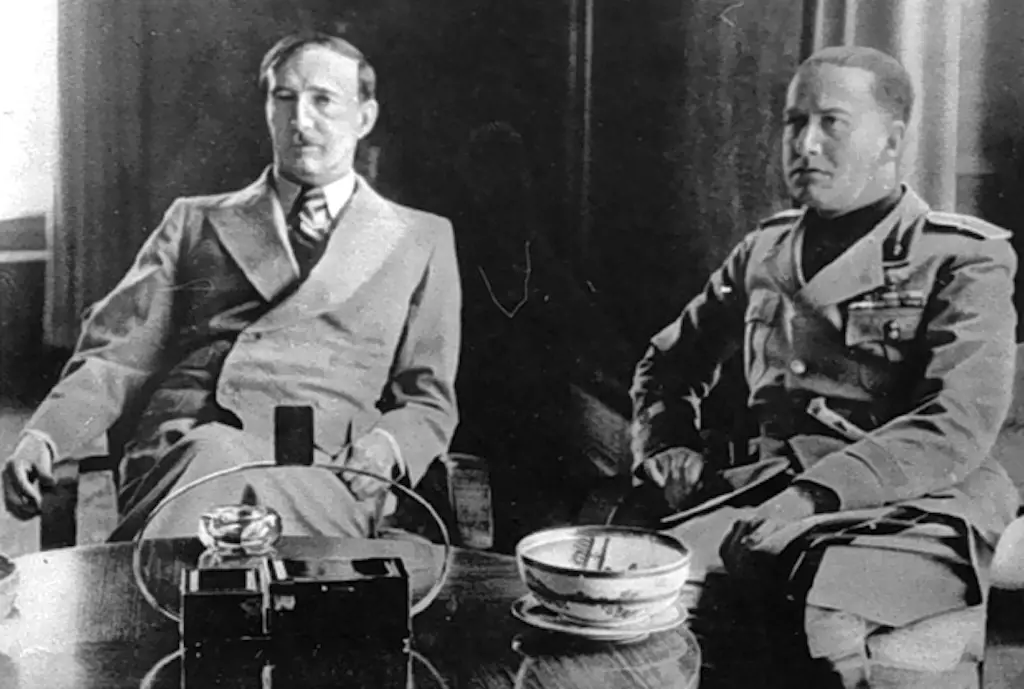
King Zog I and Italian Foreign Minister Galeazzo Ciano meet in 1936.
In the early 1900s, Albania was swept in political and social instability. Albania’s King Zog I (Ahmet Muhtar Bej Zogolli) was in need of financial aid and economic support to get his country back on track. In order to help his country, King Zog signed a number of accords with Italy, which had a long-standing political and financial interest in Albania. Mussolini used this debt as a reason for annexation. In March of 1939, Mussolini sent Foreign Minister Ciano to Albania to meet with King Zog and review a list of demands made by Mussolini. This list, according to Ciano, was impossible to accept.
Not surprisingly, King Zog reviewed these demands and denied them. Rome then sent King Zog an ultimatum to accept those demands by 12:00 PM on 6 April 1939.
On Friday, April 7, 1939, the Italian fleet was off the coast of Albania. By the end of that day, two divisions of 4 Bersaglieri regiments and a battalion of tanks led by General Guzzoni land throughout the coast of Albania.
Italian Invasion of Albania 1939
Resistance was weak and sporadic. On 8 April 1939, King Zog along with his wife and son escape to the Greek authorities in Florina and granted asylum by Athens. Albania surrendered to Fascist Italy. On 16 April 1939, King Victor Emmanuel III united the crown of Albania to that of Italy and the Ethiopian Empire.
An Outdated Arsenal of Weaponry
Italy maintained an outdated Air Force and WWI grade artillery. Germany outgunned Italy with military might in a number of ways. First, Germany had a vast amount of resources to pull from, ranging from iron ore to petroleum. Second, they started their military buildup from scratch. Germany was severely beaten in World War I. When Hitler started the German re-militarization, the German war machine was modern and efficient. In effect, it is easier to start over than an attempt to maintain or refurbish obsolete weaponry.
Greece Feels Threatened
When Italy annexed Albania, Greece began to feel threatened. The Greek government believed Italy would make Greece her next target. Italian bases already existed in their vicinity with installations on the Dodecanese Islands. Greece was also well aware that Italy would soon install bases in Albania. There was a fear that Italian bombers would soon land at the airports of Maleme and Crete and Italian submarines would soon infest the waters of the Souda Bay, the port of Alexandria and the Suez Canal.
In an attempt to curb German as well as Italian expansion, Paris and London furnished Greece the same guarantee given to Poland; any aggression on Greece will be met with all the military help possible. This statement forced Italy to look at the Axis alliance with Germany and try to incorporate it into a military pact. Mussolini was prepared to forge a military alliance with Germany and even to go to war with France. He felt his only need would be economic and material aid.
At this point in history, France was more likely to go into war with Italy than with Germany. Setbacks occurred on the 12 March 1939 in Franco-Italian negotiations dealing with the Red Sea and Spain. Italian naval vessels in the Mediterranean, as well as military installations in occupied Libya, put a stranglehold on the French Mediterranean fleet. To make matters worse, Mussolini taunted the French Ministry of Council, President Edouard Daladier, in front of his news reporters.
The Pact of Steel
There were a few problems in concluding a military pact with Germany. First was the issue of Japan. Mussolini wanted Japan in this alliance, but Hitler distanced himself from having Japan involved. He felt allowing Japan in this military alliance would pull the United States out of its isolationist stance and towards the allies. The second problem was the issue of the Nazi view of Catholicism. In order for the people of Italy to feel comfortable with an Italo-German military alliance, Germany would have to soften their stance against the Catholic religion. German Foreign Minister Von Ribbentrop accepted this compromise without question. The final issue was Conte Ciano’s fear of an alliance with Germany. In his diaries, Conte Ciano wrote about the dangers of a military alliance with Germany.
(Ribbentrop) has in his head the idea of war…he wants war, his war. He doesn’t have a precise direction to go, or at least he doesn’t mention it. He mentions no enemy or no objective But he wants a war in 3 or 4 years. I am being reserved, but I did make it clear to him that we have other problems to resolve and other concessions that may have to be made.
A Tragic Bluff
Conte Ciano admitted in his diaries that they provided Mussolini an inflated number of men in the army, and multiplied the number of divisions. The artillery is old and the anti-aircraft and anti-tank weaponry left much to be desired. The Major General of Aviation declared that Italy had 3,006 available aircraft, but Informational Services declared only 982 ready aircraft…a gross exaggeration. It was a tragic bluff. Needless to say, Mussolini was upset at the lack of preparedness of the Esercito and the Regia Aeronautica.
Timeline to War
Mussolini concluded that Italy required a period of peace in order to incorporate the following agendas.
- Organize Libya and Albania and settle the unrest in Ethiopia to the point of obtaining 500,000 army volunteers.
- Complete construction and modernization of six Battleships
- Modernize existing medium and large-caliber artillery pieces.
- Repatriate all Italians working in France for military and moral reasons.
- Terminate the transference, already in progress, of all wartime industries from the Po Valley to Meridial Italy.
- Bring Germany and Italy closer together, not just in government, but also as a people. An existence between Church and Nazism.
Italy knew that war in Europe was inevitable, but Ciano convinced Mussolini not to hurry the timing. The possibility existed that war between Japan and China could be over by the time these agendas are complete. If war with Germany and Poland start before the 3-4 year time period, and if it is localized between those two countries, Italy shall supply Germany with all the political and material aid it could muster. But if France and England come to the defense of Poland, Italy must claim neutrality until its forces are prepared for a lengthy war.
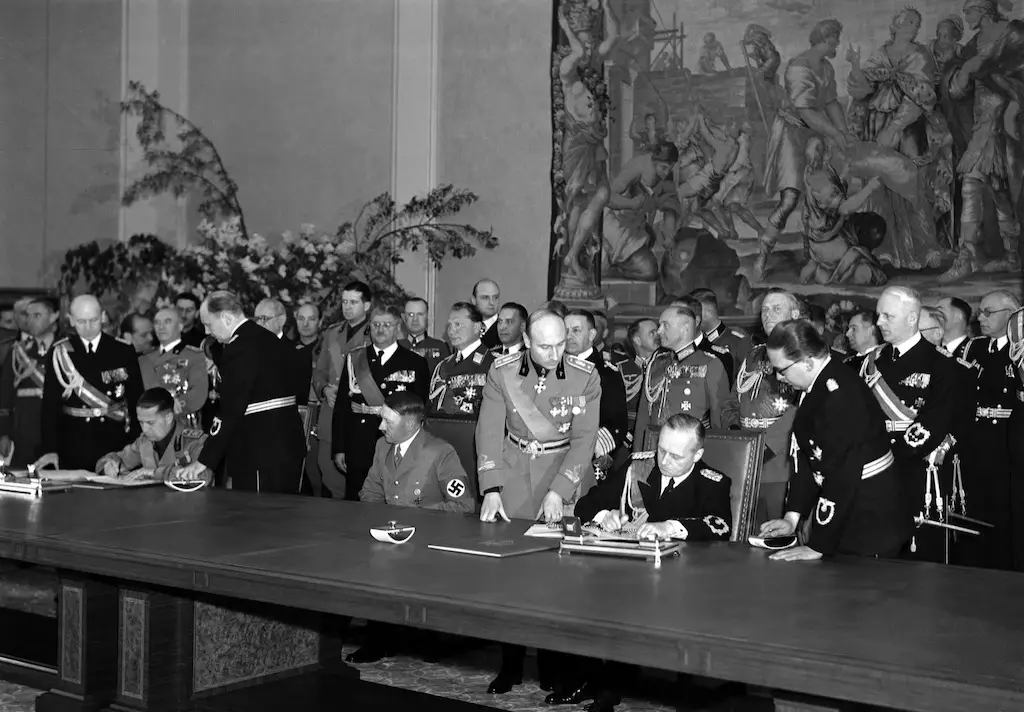
The signing of the Pact of Steel.
Ribbentrop agreed to this new Italian policy and stated that Germany had no intention of starting a war for 3-4 years. On 21 May 1939, Ciano flies to Berlin and the Pact of Steel is signed the next day.
In September of 1939, Germany invades Poland and Europe goes to war.