Background on the Beretta M1918
The Beretta modello 1918 is a submachine gun which entered service with the Italian military in 1918. The Beretta M1918, like the OVP, is little more than the Villar-Perosa (VP) mechanism presented in a more convenient form. The Regio Esercito approached Beretta at the same time as OVP with the request to convert the cumbersome VP into a more practical weapon. Tuillio Marengoni ultimately designed the Beretta modello 1918.
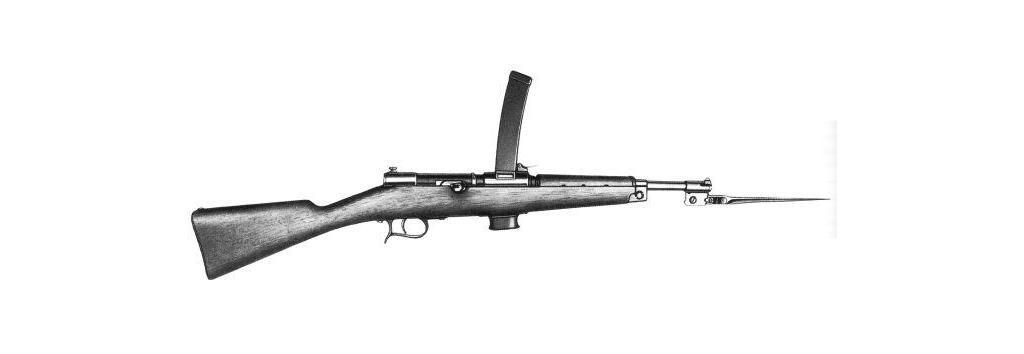
Beretta M1918
Function
Modifications consisted of fitting a new trigger mechanism based on the standard Italian service rifle of the day, a long wooden stock with an ejection slot underneath and a folding bayonet similar to that used on Italian carbines. The result was a practical and handy weapon. The mechanism remained unchanged, still using the rotating bolt system and the slotted curved magazine fitted into the top of the action.
Service
The Ardite regiments of the Italian Army obtained the Beretta modello 1918 in early 1918 and thus became the first submachine gun to become standard issue, predating the German Bergmann by a few weeks. The Model 1918 remained in service until World War II.
Beretta M1918 saw action in the Spanish Civil War and the Abyssinian war and frequently encountered in the early phases of the Libyan campaign in 1941.
Specifications
| Model | Beretta M1918 |
|---|---|
| Caliber | 9 mm Glisenti |
| Barrel | 6 grooves with right-hand twist |
| Length | 43 in (1092 mm) |
| Barrel Length | 12 in (305 mm) |
| Weight | 7 lbs 3 oz (3.3 kg) |
| Feed System | 25 round detachable box magazine |
| Rate of Fire | 900 RPM (Cyclic) |
| System of Operation | Blowback/Automatic only |