Background on Ugo Cavallero
Ugo Cavallero was born in Casale Monferrato on 20 September 1880. He spent his youth in Ponzano and in 1898 he went to Modena to study in the Scuola Militare. He served as Second Lieutenant in the 59th Infantry Regiment in 1900. In 1904, he achieved the rank of Lieutenant and became an instructor in the Scuola Centrale di Tiro in Parma. After three years, he started his studies in the Scuola di Guerra and graduated first of his class in 1911. Ugo Cavallero held a degree in pure mathematics. As a man of culture, he translated history and military books from German and English since he knew both languages perfectly.
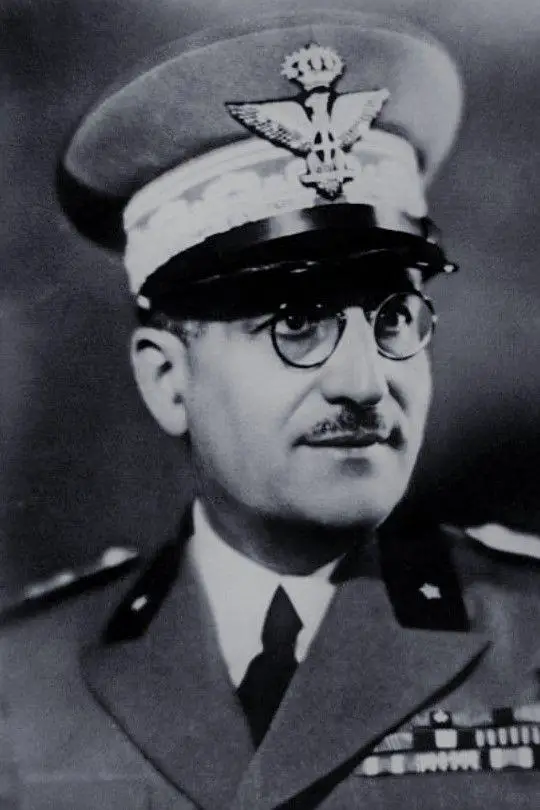
Ugo Cavallero
Early Military Service
In 1912, Cavallero became Captain in the general staff of the Torino Division. After fighting in Libya in May 1913, he was awarded the Medaglia di Bronzo al Valor Militare for his courage during the battle of Sidi el Garbàa.
Following his return to Italy, Cavallero transferred to the 1st Alpini Regiment. In May 1915, he became the Secretary of the Chief of General Staff of the Army and promoted to Major in December.
World War One
Cavallero’s next assignment was the Ufficio Operazioni where he became highly appreciated for his rational organizational skills. His work there earned the Croce di Cavaliere dell’Ordine Militare d’Italia. Cavallero achieved the rank of Colonel in October 1917. Because of his exceptional work in December 1918 as Chief of Operations Office of the Comando Supremo, he was promoted to Brigadier-General.
Cavallero co-authored the battle plans for Piave and of Vittorio Veneto, which led to the complete defeat of the Austro-Hungarian Army in October-November 1918.
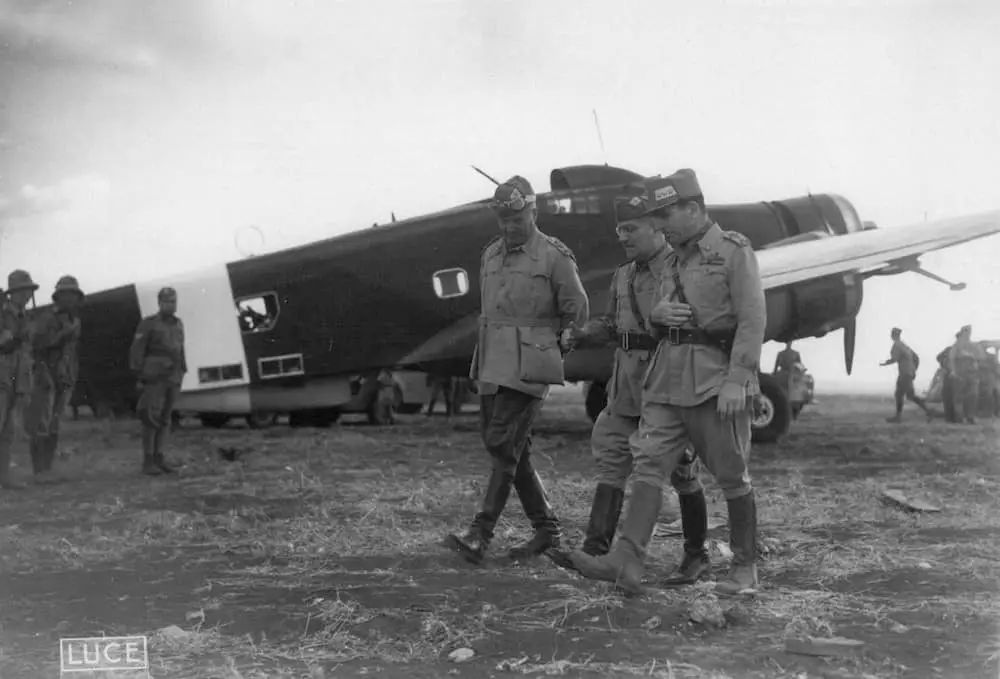
Left to right, Generals Curio Barbasetti di Prun, Ugo Cavallero and Ettore Bastico in Libya, 1942.
Under-Secretary of the Ministry of War
In February 1919 Cavallero became nominated the president of Italian military delegation to the Permanent Inter-Allied Committee in Versailles. But in June, he requested a leave of absence and became general manager of Pirelli. He returned to service in May 1925 as Under-Secretary of the Ministry of War. Benito Mussolini held the position of Minister of War and Prime Minister, so Cavallero, in essence, held complete control of the Ministry.
In 1926, Cavallero, along with General Pietro Badoglio, reorganized the Regio Esercito. In the same year, Cavallero became Senator and, in 1927, a Major-General. Cavallero had conflicts of interest with Badoglio, who was Chief of General Staff since 1925, because he was the inspiration of Royal Decree number 68 of 6 February 1927. This law drastically diminished the powers of the General Staff.
President of Ansaldo
Cavallero resigned from the Ministry and received the title of count by the King. In 1928, Cavallero became president of Ansaldo, the largest Italian heavy industry group. He left Ansaldo in 1933 after an inquiry revealed substandard or forged armor plates installed on a Cruiser. Allegations suggested he attempted to gain profit by using inferior products. However, he was ultimately found not guilty.
Return to the Regio Esercito
After leaving Ansaldo, Cavallero spent some time as a delegate of the Geneva Conference for Disarmament. However, the Regio Esercito recalled Cavallero to active service in November 1937 and promoted to the rank of Generale di Corpo d’Armata for duties as the Supreme Commander of the Armed Forces in East Africa. This position lasted until April 1939 until he subsequently transferred to Italy following a disagreement with the Viceroy, Amedeo d’Aosta. Cavallero received the Medaglia d’Argento al Valor Militare and promoted to Generale d’Armata on 10 May 1940. His duties entailed being the Vice President of the Economic and Military Commission regarding the Pact of Steel with Germany.
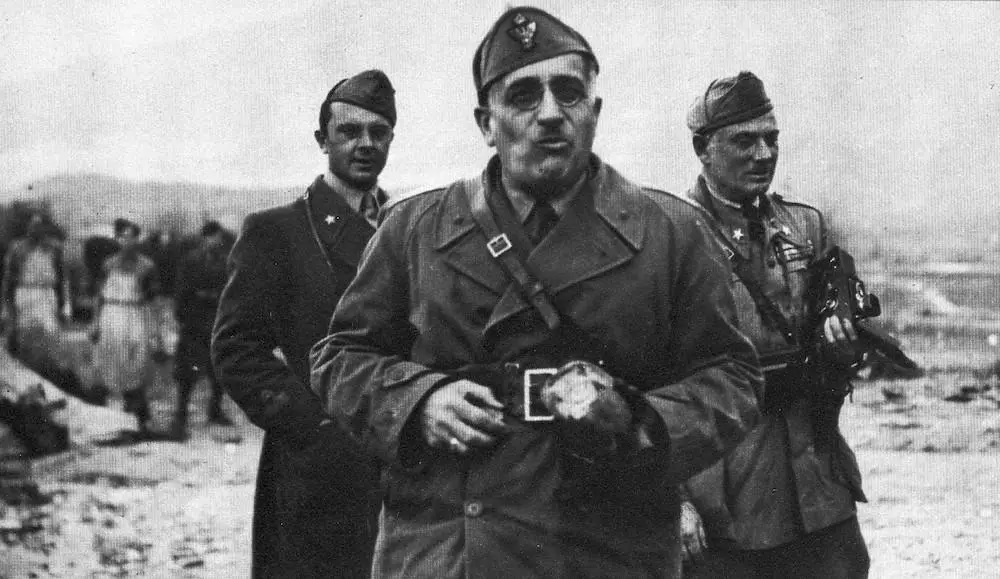
Ugo Cavallero (center) in 1943.
Replacing Badoglio as Chief of Staff
Cavallero became Chief of Defense Staff on 6 December 1940 following the resignation of Field Marshal Badoglio due to his disappointing leadership in the war. He also assumed the duties of Commander of Italian Forces fighting against Greece on 30 December 1940. Thanks to his organizational ability, the Greek counter-offensive came to a halt in January 1941. In March 1941, he initiated a limited offensive in Greece. It did not break the strong Greek lines but did exhaust the enemy army. After the occupation of Greece became successful, Cavallero returned to Italy.
Friendship with Kesselring
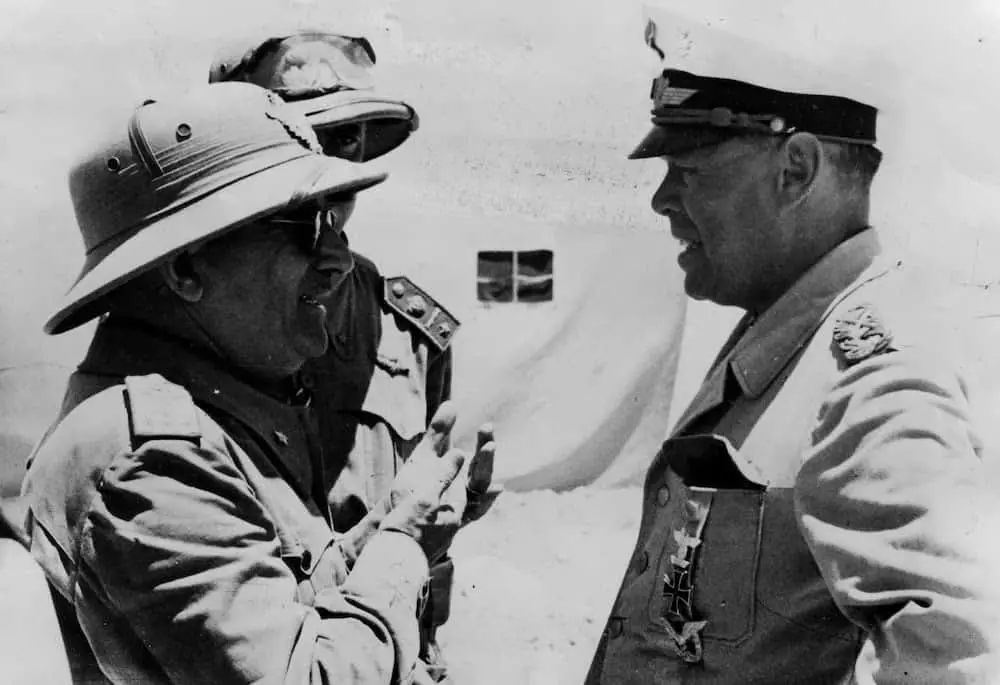
A conversation between Ugo Cavallero and Albert Kesselring on 28 July 1942.
Thanks to the law of 27 June 1941 authorizing Cavallero managerial power on the Chiefs of Staff of the three Armed Forces, he restructured Comando Supremo and fostered improved joint force cooperation. During his command, he became friends with Field Marshal Albert Kesselring. Although the had no obligation to do this, Cavallero would forward his orders to the German Field Marshal for feedback. Like Kesselring, he opposed General Rommel’s 1942 offensive in Egypt. However, Rommel convinced Hitler and then Mussolini of the necessity for his attack. Following Rommel’s promotion to Field Marshal, Cavallero subsequently became Maresciallo d’Italia on 1 July 1942 to prevent Rommel from outranking him.
The Downfall
The subsequent Axis defeats at El Alamein, the Don River, and the loss of Libya led to Cavallero’s replacement at Comando Supremo by General Vittorio Ambrosio on 1 February 1943.
Furthermore, on 25 July 1943, the Fascist Grand Council voted to oust Benito Mussolini from power. King Vittorio Emmanuelle appointed Field Marshall Pietro Badoglio as the new Prime Minister. One of Field Marshal Badoglio’s first moves included the prevention of any possible fascist rebellion stemming from the recent arrest of Mussolini. This meant the arrest of all known Fascist leaders.
Arrest
Cavallero had been a close friend of fascist leader Roberto Farinacci, and therefore, believed by Badoglio to be pro-Fascist. This led Badoglio to call for his arrest on 22 August 1943 and subsequent imprisonment at Fort Boccea.
On 27 August 1943, Cavallero, fearing for his career and probably for his life, wrote a memorandum to Badoglio claiming himself as an anti-fascist and that he actually plotted for the end of Mussolini’s government. Badoglio did not believe him.
Cavallero’s Memorandum
Shortly after the armistice on 09 September 1943, Badoglio escaped Rome for Pescara and Brindisi to be closer to Allied protection. On 12 September, German forces rescued Cavallero and escort him to their high command in Frascati, located a short distance from Rome. While at Frascati, Field Marshal Albert Kesselring offered Cavallero command of the Italian forces in the newly nascent Italian Social Republic. Whether on purpose or on accident, Cavallero’s letter claiming to be anti-fascist had been conveniently left on Badoglio’s desk and discovered by the Germans. When the SS read it, the Germans believed he was an anti-fascist and a traitor.
Death of Ugo Cavallero
On the morning of 14 September 1943, Ugo Cavallero was found dead in the garden of Hotel Belvedere located near Frascati. He has a pistol shot to his temple. Earlier that evening he had dinner and a meeting with Kesselring. A theory suggests Cavallero refused the offer made by Kesselring and realized he had no option other than suicide. Another theory suggests German officers informed Cavallero of the discovery of the letter. Because of that, Cavallero may have been killed by Germans or simply committed suicide. What is known is Cavallero did not intend to break his oath to the King. Cavallero intended to refuse Kesselring’s offer. There are also very few options left when charged with treason by both Pietro Badoglio’s Italian government and by Germany.
Ugo Cavallero’s war diary “Comando Supremo 1940-1943” was published in 1948 by his son Carlo Cavallero and his wife, Countess Olga Grillo.
Written by: Guido Abate